
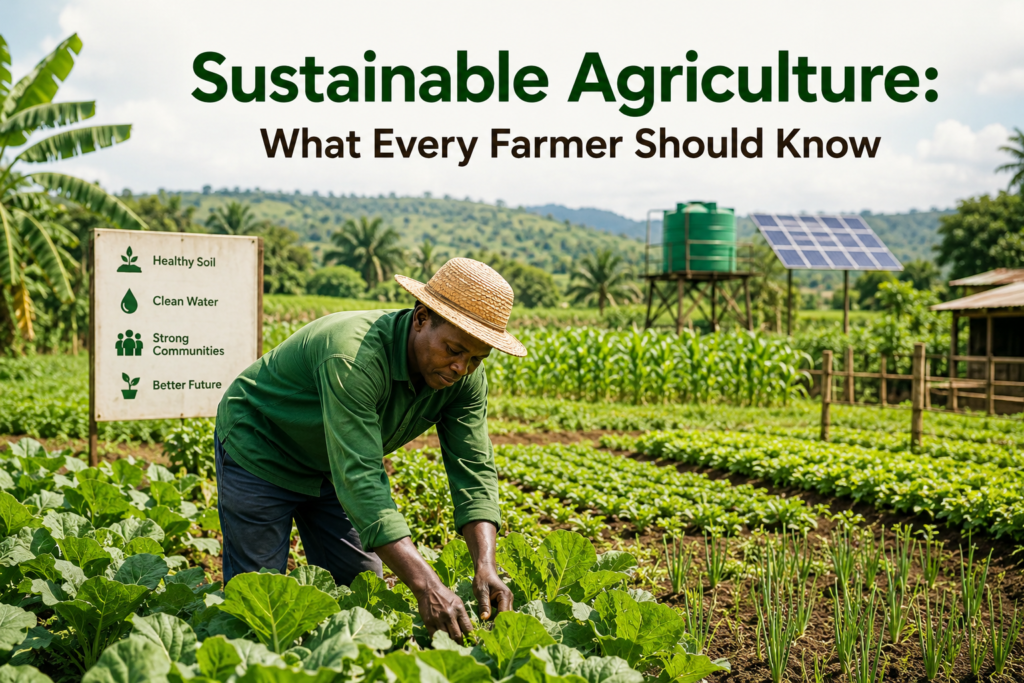
Sustainable Agriculture: What Every Farmer Should Know
Sustainable Agriculture: What Every Farmer Should Know 🌱
Agriculture provides food, creates jobs, supports businesses, and contributes greatly to the economy. But as the population grows and environmental challenges increase, farmers need ways to produce food today without making it difficult to farm in the future.
This is where sustainable agriculture comes in.
What Is Sustainable Agriculture?
Sustainable agriculture is a way of farming that aims to produce enough food and income while protecting the soil, water, plants, animals, and other natural resources needed for future farming.
In simple terms, it means:
Farm today while protecting the ability to farm tomorrow.
Sustainable farming considers three important areas:
🌱 Environmental sustainability – protecting natural resources and the environment.
💰 Economic sustainability – ensuring farming can remain financially viable.
👨🏾🌾 Social sustainability – supporting farmers, workers, families, and communities.
Why Is Sustainable Agriculture Important?
Traditional farming practices can sometimes lead to problems such as soil degradation, water pollution, loss of biodiversity, and unnecessary waste.
Sustainable agriculture helps farmers manage these challenges while maintaining productive farms.
1. It Protects the Soil
Healthy soil is one of a farmer’s most valuable resources.
Practices such as crop rotation, adding appropriate organic matter, reducing unnecessary soil disturbance, and preventing erosion can help maintain soil quality.
Healthy soil can support better crop production over time.
2. It Helps Conserve Water
Water is essential for agriculture, but it must be used wisely.
Farmers can improve water management by using appropriate irrigation methods, maintaining irrigation systems, collecting rainwater where practical, and choosing farming practices suited to local conditions.
Using water efficiently can reduce waste and help farms cope with periods of limited rainfall.
3. It Reduces Waste
A significant amount of agricultural waste can occur during harvesting, storage, transportation, and processing.
Farmers can reduce waste by:
Harvesting crops at the appropriate time.
Using suitable storage facilities.
Handling produce carefully.
Planning production according to market demand.
Finding useful applications for suitable farm by-products.
Reducing waste can also help farmers save money.
4. It Encourages Crop Diversity
Growing different crops instead of depending entirely on one crop can have several advantages.
Crop rotation and diversification can help farmers manage certain pests and diseases, improve soil management, and spread production risks.
For example, a farmer might rotate crops across different seasons rather than planting the same crop continuously on the same piece of land.
5. It Promotes Responsible Use of Farm Inputs
Fertilizers, pesticides, herbicides, and other agricultural inputs can be useful when properly selected and applied.
However, unnecessary or incorrect use can waste money and potentially harm the environment.
Farmers should follow appropriate recommendations, product labels, and guidance from qualified agricultural professionals when using farm inputs.
6. It Supports Biodiversity
Biodiversity includes the variety of plants, animals, insects, microorganisms, and other living organisms found in an ecosystem.
Farmers can support biodiversity by maintaining appropriate vegetation around farms, protecting useful habitats, and using farming practices that reduce unnecessary harm to beneficial organisms.
A healthy agricultural ecosystem can contribute to long-term farm productivity.
7. It Can Improve Farm Income
Sustainability is not only about protecting the environment. A farm must also make economic sense.
Reducing unnecessary input costs, minimizing waste, improving productivity, adding value to farm products, and finding reliable markets can help make a farm more financially sustainable.
For example, processing crops into products that have greater market value can create additional income opportunities.
8. It Helps Farmers Prepare for Climate Challenges
Weather patterns can affect farming significantly.
Sustainable practices can help farmers become more prepared for challenges such as irregular rainfall, drought, flooding, soil degradation, and changing temperatures.
Farmers can consider practices such as crop diversification, improved water management, soil conservation, and selecting crops that are appropriate for local conditions.
9. It Encourages the Use of Appropriate Technology
Technology can make sustainable farming more efficient.
Examples include:
Weather and farm-management apps.
Improved irrigation systems.
Soil-testing tools.
Modern farm machinery.
Digital marketplaces.
Satellite and remote-sensing technologies.
Data-based farm planning.
Farmers do not necessarily need expensive technology. Even simple tools that help improve decision-making can make a difference.
10. Sustainable Agriculture Starts With Small Steps
A farmer does not have to completely transform a farm overnight.
Sustainability can begin with simple improvements.
A farmer could start by:
Step 1: Understanding the condition of the soil.
Step 2: Reducing unnecessary waste.
Step 3: Improving water management.
Step 4: Keeping accurate farm records.
Step 5: Diversifying crops or farm activities where appropriate.
Step 6: Learning about improved farming practices.
Step 7: Seeking advice from agricultural extension professionals.
Small improvements made consistently can contribute to long-term progress.
Challenges of Sustainable Agriculture
Although sustainable farming has many benefits, farmers may face challenges when adopting new practices.
These may include:
Limited access to finance.
Lack of agricultural information or extension services.
High costs of some technologies.
Limited access to markets.
Unpredictable weather.
Difficulty changing established farming practices.
Because of these challenges, farmers, governments, agricultural organizations, researchers, financial institutions, and private businesses all have roles to play in supporting sustainable agriculture.
Sustainable Agriculture in Nigeria 🇳🇬
For Nigeria, sustainable agriculture is particularly important because agriculture supports millions of livelihoods and plays a major role in food production.
Farmers across different parts of the country face different conditions, so sustainable practices should be adapted to local environments and farming systems.
Improving soil management, reducing post-harvest losses, using water responsibly, strengthening agricultural knowledge, and improving access to markets can all contribute to a more sustainable agricultural sector.
Final Thoughts
Sustainable agriculture is about finding a balance between producing food, earning a living, and protecting natural resources.
The goal is not simply to produce more today. It is to build farming systems that can continue producing food and supporting communities for many years.
🌱 Protect the soil.
💧 Use water wisely.
🌾 Reduce waste.
👨🏾🌾 Support farmers.
💰 Build profitable farms.
The future of agriculture depends not only on what we produce, but also on how responsibly we produce it.
💬 What Do You Think?
Which sustainable farming practice do you think Nigerian farmers should adopt more widely?
Share your thoughts in the comments and let’s start a conversation about the future of agriculture.