
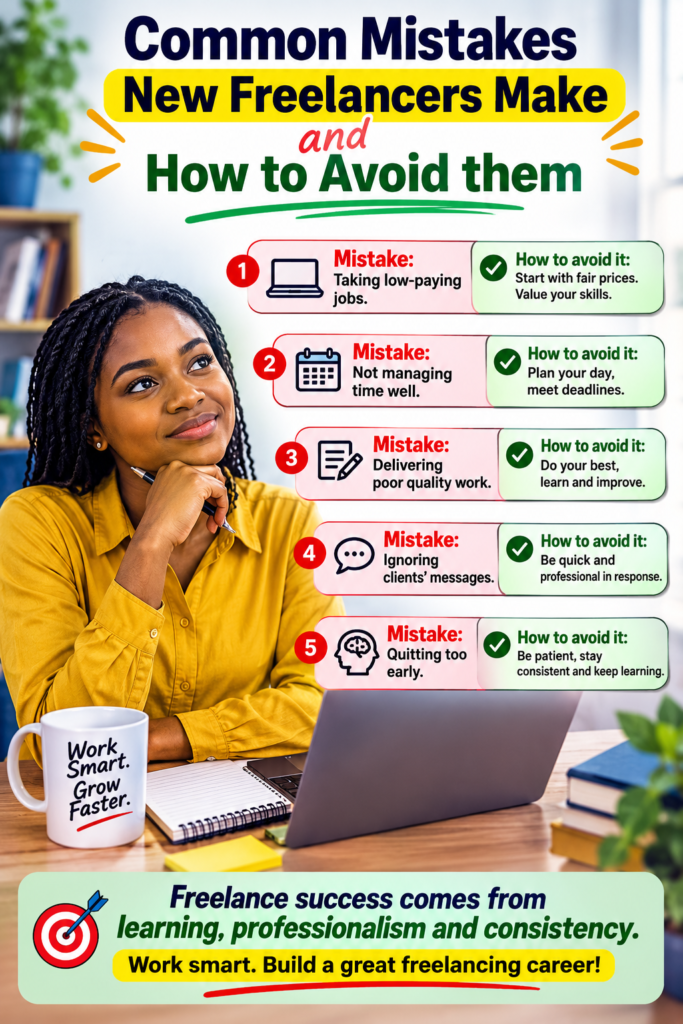
7 Common Mistakes New Freelancers Make (And How to Avoid Them)

7 Common Mistakes New Freelancers Make (And How to Avoid Them)
You’ve finally taken the leap. You’ve set up your website, updated your portfolio, and told your friends you’re now a “solopreneur.”
But three months in, you’re exhausted, broke, and wondering if you should just go back to a 9-to-5.
I’ve been there. And I’ve watched hundreds of new freelancers make the same painful errors. The good news? Every single one is avoidable.
Here are the 7 most common mistakes I see new freelancers make—and exactly how to dodge them.
—
Mistake #1: Saying “Yes” to Everything
When you’re starting out, every project feels like a lifeline. You take the low-paying blog post, the logo redesign, the social media management, and the website build—all at the same time.
Why it’s a problem: You become a “jack of all trades, master of none.” Your portfolio looks messy, you’re exhausted from context-switching, and your quality drops across the board.
How to avoid it:
Pick a niche (even a temporary one). Instead of “I write content,” say “I write email newsletters for SaaS startups.” You’ll attract higher-paying clients faster because you speak their specific language.
—
Mistake #2: Underpricing to “Get Experience”
It’s the classic trap: “I’ll charge $20 an hour to build my portfolio, then raise my rates later.”
Why it’s a problem: It is 10x harder to raise rates with an existing client than to start at the right price. Plus, cheap clients are often the most demanding and the least respectful of your time.
How to avoid it:
Charge based on value, not hours. If a project saves a client $10,000, charging $1,000 is a bargain. Start with project-based pricing rather than hourly. If you must start low, set a clear “expiration date” for that rate with the client upfront (e.g., “This rate is for the first 3 months only”).
—
Mistake #3: Skipping the Contract (Every. Single. Time.)
“We’re friends, we don’t need a contract.” Or, “It’s a small project, it’s not worth the hassle.”
Why it’s a problem: Scope creep. Endless revisions. Late payments. No contract means you have zero legal or financial recourse when things go south.
How to avoid it:
Use a simple, one-page contract that covers:
· Scope of work (exactly what you will and won’t do)
· Timeline (milestones and final deadline)
· Payment terms (50% upfront, 50% upon completion)
· Revision limit (e.g., 2 rounds of changes)
You can find free templates via HelloBonsai or LawDepot to get started today.
—
Mistake #4: Not Having a “Client Onboarding” Process
You get a new inquiry, reply with a quote, they say yes, and you immediately start working. Chaos ensues.
Why it’s a problem: Without a system, you forget to ask for assets, miss brand guidelines, and waste hours playing “email tag” to get basic info.
How to avoid it:
Create a simple onboarding questionnaire (use Google Forms or Typeform) that you send to every new client before you start. Ask for:
· Their goals for the project
· Brand voice/tone
· Competitors they admire
· All necessary logins and assets
This makes you look profoundly professional and saves you 5+ hours per project.
—
Mistake #5: Treating It Like a Hobby, Not a Business
Working in your pajamas on the couch, checking Instagram every 20 minutes, and only working “when you feel inspired.”
Why it’s a problem: You will miss deadlines, burn out from cramming on Sundays, and struggle to pay rent.
How to avoid it:
Set “CEO Hours” and “Maker Hours.”
· CEO Hours (Morning): Prospecting, emailing clients, invoicing, marketing.
· Maker Hours (Afternoon): Deep, focused creative work.
Use a time-blocking method (like the Pomodoro Technique) and track your hours for the first month to see where your time is actually going.
—
Mistake #6: Ignoring the “Pipeline”
You land one amazing client, give them 100% of your focus, and stop pitching. When that project ends in 6 weeks, you have zero work lined up.
Why it’s a problem: The “feast or famine” cycle is the #1 reason freelancers quit. It creates panic, which makes you take bad clients.
How to avoid it:
Dedicate 1 hour every single day to business development. This means:
· Sending 2-3 cold emails
· Responding to job posts on Upwork/LinkedIn
· Nurturing past clients (sending a quick “checking in” email)
You should always have 3 prospects in your pipeline, even when you’re fully booked.
—
Mistake #7: Failing to Save for Taxes (The Silent Killer)
You get a $5,000 payment and think, *“I’m rich!”* So you spend it all. Then tax season comes, and you owe $1,500 you don’t have.
Why it’s a problem: Self-employment tax is higher than employee tax (in the US, ~15.3% just for Social Security/Medicare, plus income tax).
How to avoid it:
Open a separate, high-yield savings account specifically for taxes.
Rule of thumb: Transfer 30% of every single payment into this account immediately. Don’t touch it. Pay your quarterly estimated taxes on time to avoid penalties (use a tool like QuickBooks Self-Employed to calculate this).
—
Your Turn: Start Today
Freelancing is the greatest career choice I ever made—but it’s a skill, just like writing or design. You will stumble, but if you avoid these 7 pitfalls, you’ll accelerate your success by months, if not years.
Here’s your challenge for today:
Pick one mistake from this list that you’re currently making. Fix it in the next 2 hours. Write a simple contract, open a tax account, or create that onboarding form.
Got a mistake I missed? Drop it in the comments below—let’s help the new freelancers out there!